Azure App Service and Windows Containers

Containerisation of applications is something that is becoming more and more common. Allowing developers to “wrap” all requirements into an individual element which the infrastructure team can then deploy where resources are available opens a door to the most modern options in application deployment and management.

Enter Azure App Service, which for years now has been removing the need for an infrastructure management layer and allowing teams to focus on deployment and performance. Traditionally, you had to deploy your apps within the allowed parameters of your App Service Plan (ASP). However, you can now run containers as part of this platform.

Combine this with a Container Registry, such as Azure Container Registry and you can deploy images within minutes. These images can then be scaled within your ASP to meet demand and can be updated as required using your current CI/CD processes.

This had been limited to Linux based containers, but Microsoft have recently announced a public preview of the ability to run Windows containers within your ASP. This is targeted towards customers interested in migrating .NET applications to Azure, and hoping to avail of a PaaS service to get the many productivity benefits such as high availability within and across Azure regions. This can also increase application redundancy options by using integrated backup/restore and app cloning options.

WebAppForContainers
Example deployment scenario

The preview capabilities are appropriate for testing and POC environments, but there are of course some limitations and preview deployments are not recommended for production workloads in any scenario.

Within the preview the following is supported:

  • Deploy containerized applications using Docker Hub, Azure Container Registry, or private registries.
  • Incrementally deploy apps into production with deployment slots and slot swaps.
  • Scale out automatically with auto-scale.
  • Enable application logs and use the App Service Log Streaming feature to see logs from your application.
  • Use PowerShell and Win-RM to remotely connect directly into your containers.

For a quick start/how-to see the following link.

First Impressions – Azure Firewall Preview

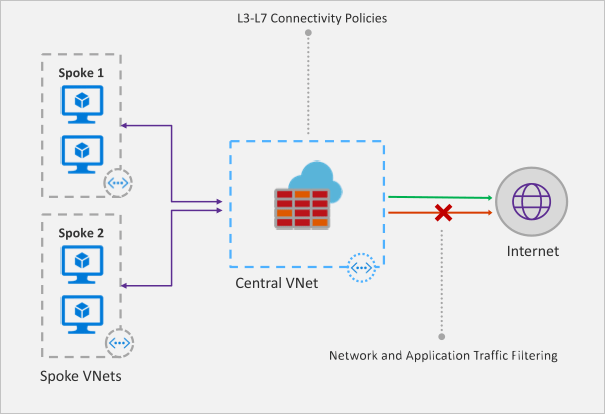
Recently Microsoft announced that a new Azure Firewall service was entering a managed public preview. Azure Firewall is a managed, network security service that protects your Azure Virtual Network resources. It is a fully stateful firewall as a service with built-in high availability and scalability.

firewall-overview.png

The services uses a static public IP meaning that your outbound traffic can be identified by third party services as/if required. Worth nothing, that only outbound rules are active within this preview. Inbound filtering will hopefully be available by GA.

The following capabilities are all available as part of the preview:

  • Stateful firewall as a Service
  • Built-in high availability with unrestricted cloud scalability
  • FQDN filtering
  • Network traffic filtering rules
  • Outbound SNAT support
  • Centrally create, enforce, and log application and network connectivity policies across Azure subscriptions and VNETs
  • Fully integrated with Azure Monitor for logging and analytics

As with all previews it should not be used for production environments, but for testing purposes this is how to register your tenant for deployment.

To enable the Azure Firewall public preview follow the guide here: Enabling the preview

Once enabled, follow this tutorial for a sample implementation: Deployment Tutorial

Now that you’re familiar with the deployment, you should apply to your specific test scenarios. Be wary of some operations that could be limited by applying a default route to your VM. There is an updated FAQ for the service here: Azure Firewall FAQ

Overall, this is a welcome addition to Azure networking. As the preview progresses and more service options are added, especially inbound options, I see this being as common as deploying an NSG in your environment. Combining it with peering and the right set of rule collections for your environment allows for an easily managed, scalable, and most importantly, secure environment within Azure with minimal cost and infrastructure footprint.

Securing Azure PaaS

When considering Azure as a platform, part of the conversation should revolve around transformation. That is, how do we transform our approach from what is viewed as traditional to something more modern. Often this could lead to redesigning how your application/service is deployed, but with some workflows, a simple change from IaaS to PaaS is viewed as a quick win.

This change isn’t suitable in all scenarios, but depending on your specific requirement it could allow for greater resiliency, a reduction in costs, and a simpler administration requirement. One service that is often considered is SQL. Azure has its own PaaS SQL offering which removes the need for you to manage the underlying infrastructure. That alone makes the transformation a worthy consideration.

However, what isn’t often immediately apparent to some administrators is that PaaS offerings are, by their nature, public facing. For Azure SQL to be as resilient as possible and scale responsively, it sits behind a public FQDN. Therefore, how this FQDN is secured must be taken into consideration as a priority to ensure your data is protected appropriately.

Thankfully, Azure SQL comes with a built in firewall service. Initially, all Transact-SQL access to your Azure SQL server is blocked by the firewall. To allow traffic, you must specify one or more server-level firewall rules that enable access. The firewall rules specify which IP address ranges from the Internet are allowed. There is also the ability to choose whether Azure applications can connect to your Azure SQL server.

The ability to grant access to just one of the databases within your Azure SQL server is also possible. You simply create a database-level rule for the required database. However, while this limits the traffic to specific IP ranges, the traffic still flows via the internet.

To communicate with Azure SQL privately, you will first need an Azure V-Net. Once in place, you must enable the service endpoint for Azure SQL, see here. This will allow communication directly between listed subnets within your v-net and Azure SQL via the Azure backbone. This traffic is more secure and possibly faster than via the internet.

Once your endpoint is enabled, you can then create a v-net firewall rule on Azure SQL for the subnet which had a service endpoint enabled. All endpoints within the subnet will have access to all databases. You can repeat these steps to add additional subnets. If adding your v-net replaces the previous IP rules, remember to remove them from your Azure SQL firewall rules.

Also worth noting is the option for “Allow all Azure Services”, the presumption here is that this somehow would only access from Azure Services within your subscription, but this is not the case. It means every single Azure service in all subscriptions, even mine! My recommendation is to avoid this whenever possible, however, there are some cases where this required and this access should be noted as a risk.

More on Azure SQL Firewall – https://docs.microsoft.com/en-us/azure/sql-database/sql-database-firewall-configure

More on Azure SQL with V-Nets – https://docs.microsoft.com/en-us/azure/sql-database/sql-database-vnet-service-endpoint-rule-overview


Azure IAAS Disaster Recovery

The ability to recover your IAAS VMs in Azure to a different region has been a logical requirement within Azure for quite some time. Microsoft made the feature available in preview last year and this week have made it GA.

Azure DR allows you to recover your IAAS VMs in a different Azure region should their initial region become unavailable. For example, you run your workloads in North Europe, the region experiences significant downtime, you are now able to recover your workloads in West Europe.

In this post I will go through setting up an individual VM to replicate from North Europe to West. However, it’s worth pointing out that DR should be a business discussion, not just technical. All scenarios that could occur, within reason, should be discussed to decide whether DR is warranted. For example, if your business entirely relies on your premises for production, if you lose the premises, you don’t need DR as there is no production capability regardless of system recovery etc. The idea is to scope what DR actually means for your business and remember, DR is only valid if it is tested!

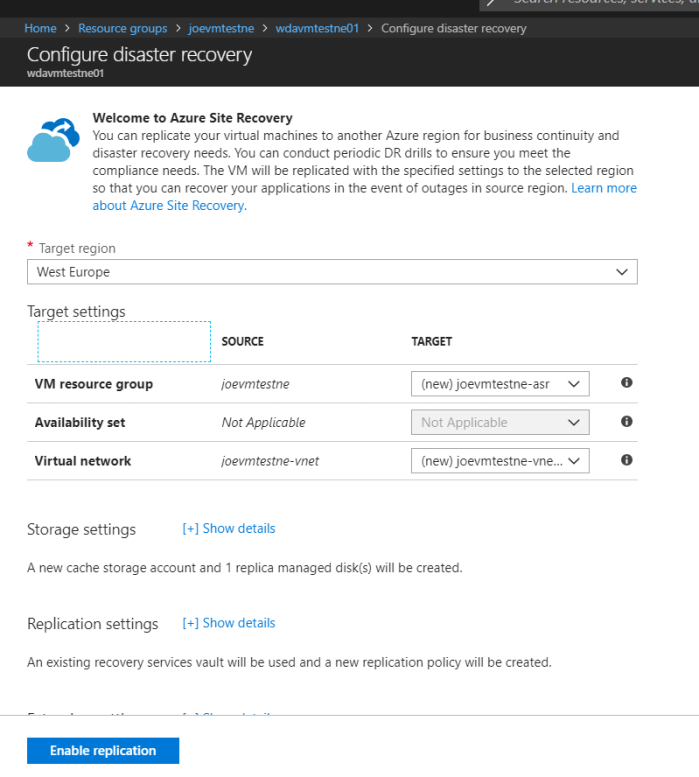
Enabling DR for a VM is straight forward. Open your VM blade and scroll down to Operations, you will see an option for Disaster Recovery

DRvmBlade

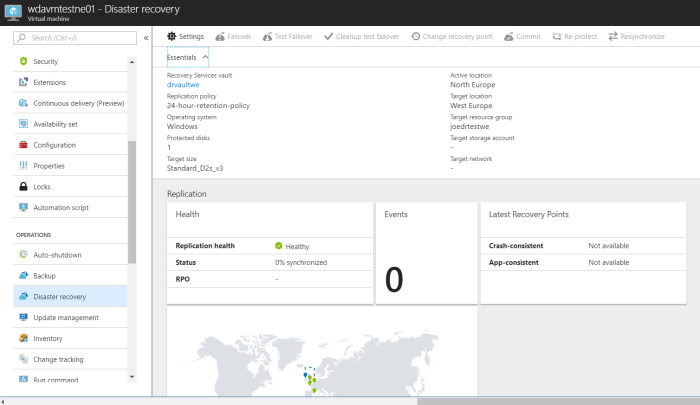
You select a Target Region that must be different from your current region, you can then choose the default settings for a POC. In my screen shot, I have created a Resource Group and Recovery Services Vault in WE already so will use those. Once submitted, replication for your VM will be enabled. You can then view the configured options:

DRvmSettings.PNG

And that’s it! Once synchronisation completes, you now have your VM protected in a different region. However, for it to be valid, you need to design and confirm your Recovery Plan then complete both a Test Failover and Complete Failover and Failback.

More reading on the overall concept and Azure-Azure DR specifics here.

Optimising Azure Disk Performance

When deploying a VM, there are several aspects of configuration to consider to ensure you are achieving the best possible performance for your application.  The most common are vCPU and RAM, however, I recommend equal consideration also be given to your disks.

In Azure, the are multiple options available when provisioning a disk for a VM. The recommendation from Microsoft is to use Managed Disks and depending on performance required choose either Standard or Premium tier. As this post is about performance, I am going to discuss Premium tier Managed Disks (PMD).

For most applications/services, if you choose the closest sizing for the VM and provision the disk as PMD, this will more than meet your requirements. However, should you have heavy read/write requirements, you may need to maximise your disk performance to ensure you are also maximising your other resources.

When talking about disk performance there will be references to disk IOPS and throughput, it is important to have an understanding of both concepts.

IOPS is the number of requests that your application is sending to the storage disks in one second. An input/output operation could be read or write, sequential or random.

Throughput or Bandwidth is the amount of data that your application is sending to the storage disks in a specified interval. If your application is performing input/output operations with large IO unit sizes, it requires high Throughput.

How actual disk performance is calculated for your VM is slightly complex. There are several variables that effect what performance is available, achievable and when you should expect throttling to occur. The key aspects however are:

  1. Virtual Machine Size
  2. Managed Disk Size

As you move up VM sizes, you don’t just increase the amount of vCPU and RAM available, you also increase the allocated IOPS and Throughput. In the following examples I’ll be comparing a DS12v2 and a DS13v2, below are their listed specifications:


Size vCPU Memory: GiB Temp storage (SSD) GiB Max data disks Max cached and temp storage throughput: IOPS / MBps Max uncached disk throughput: IOPS / MBps
Standard_DS12_v2 4 28 56 16 16,000 / 128 (144) 12,800 / 192
Standard_DS13_v2 8 56 112 32 32,000 / 256 (288) 25,600 / 384

As you can see there are significant differences across the board in terms of specifications, however, we’ll focus on the final two columns which are disk related. There are two channels of performance for disks attached to VMs. This relates to whether you choose to enabling caching on your disks. For the OS disk, Microsoft recommends read/write cache and enables it by default however for data disks, the choice is up to you. IOPS are higher when caching but throughput is lower, so it will be application/service dependent.

Similarly, as you move up PMD sizes, you increase the IOPS and Throughput available. See below for table highlighting this:

Premium Disks Type P4 P6 P10 P20 P30 P40 P50
Disk size 32 GB 64 GB 128 GB 512 GB 1024 GB (1 TB) 2048 GB (2 TB) 4095 GB (4 TB)
IOPS per disk 120 240 500 2300 5000 7500 7500
Throughput per disk 25 MB per second 50 MB per second 100 MB per second 150 MB per second 200 MB per second 250 MB per second 250 MB per second

You can see that Throughput will max out at 250mb however, on a DS13v2 if uncached you can get a maximum of 384mb. A similar restriction applies with IOPS. To achieve performance above the listed for PMD and in line with your VM size, you need to combine the disks.

For example, two P20s will give you 1TB of storage and roughly 300mb Throughput in comparison to a P30 which gives same storage but only 200mb Throughput. Obviously there is a cost consideration, but performance may justify this. To achieve this disk combination, it is best to use Storage Spaces in Windows to perform disk striping. More on that here – (Server 2016 – https://docs.microsoft.com/en-us/windows-server/storage/storage-spaces/deploy-storage-spaces-direct).

As a demo I completed the above and below are captures of testing throughput for the same scenario on a DS13v2. Firstly is our striped virtual disk. Same storage, maximum throughput.

DiskStripe

On the same VM, our single disk, same storage available, lower throughput.
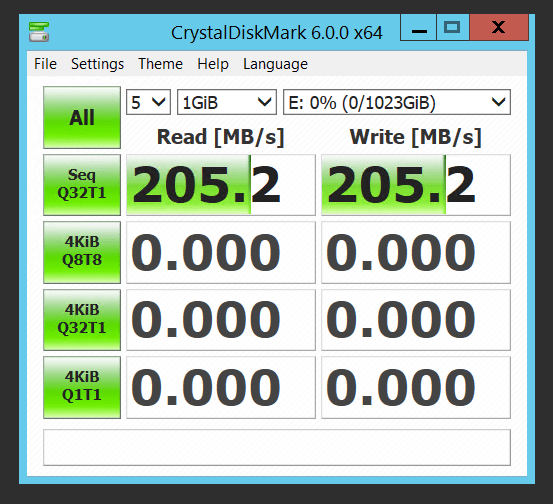
DiskSimple

A simple change to how your storage is attached produces a 50% increase in performance.

While not always applicable, changes such as the above could prove vital when considering how to size a VM for a database and at the same time ensure you are maximisng that cost/performance ratio.

More links on sizing etc.

Premium Storage Performance
VM Sizes